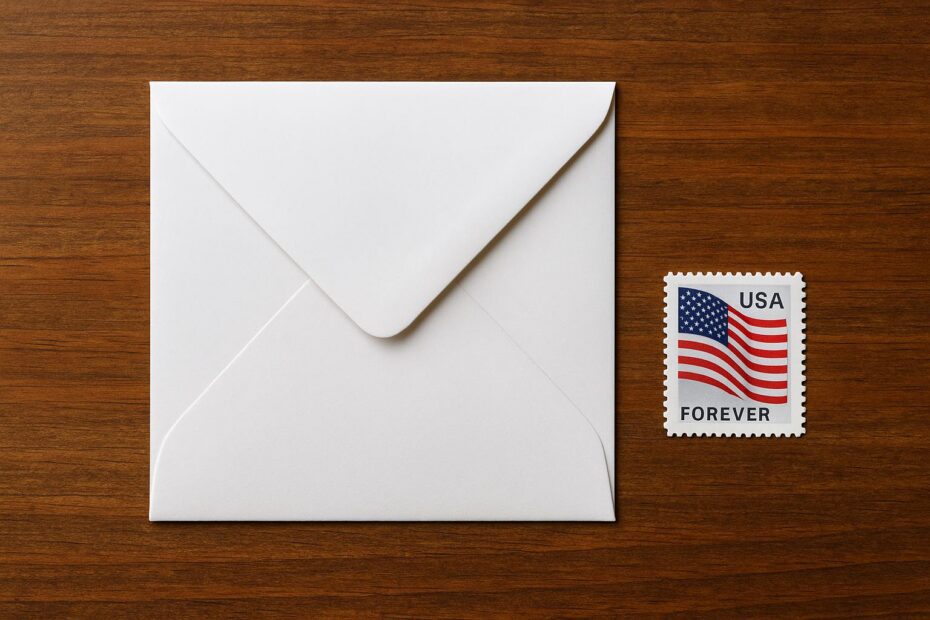
A greeting card looks like the easiest thing in the world to mail, right up until it comes back marked postage due. One Forever stamp covers most cards. It does not cover a square one, and the gap is bigger than people expect.
This page answers the stamp-count question directly. Not what the postage costs, but how many Forever stamps, additional-ounce stamps and nonmachinable stamps to actually put on the envelope to land on the right number. All rates are the USPS prices that took effect on July 12, 2026.
The stamp count for a standard greeting card
A Forever stamp is worth eighty-two cents, which is the current First-Class Mail letter rate. One Forever stamp is complete postage for a greeting card in a standard rectangular envelope weighing one ounce or less, and no second stamp is required. Most greeting cards, including the card and one folded insert, weigh well under one ounce.
The stamp count rises when the card exceeds one ounce, and the stamp count rises again when the envelope cannot be processed by automated USPS equipment. Weight and machinability are assessed separately from one another, and a card can fail one test, the other test, or both tests at once.
Square envelopes need two stamps, and neither one is a second Forever
A square envelope cannot be sorted by automated USPS equipment, because a square envelope has a length-to-height ratio of one and the equipment cannot determine which way up the envelope is. A square envelope therefore carries a nonmachinable surcharge of forty-nine cents, charged on top of the weight-based postage rather than instead of it.
A one-ounce square card requires eighty-two cents plus forty-nine cents, which is one dollar and thirty-one cents. The correct stamp count is one Forever stamp plus one nonmachinable surcharge stamp. USPS sells a nonmachinable stamp at exactly the surcharge value for this purpose, and the butterfly and similar designs issued for nonmachinable mail are the ones to look for.
Two Forever stamps are the combination most senders reach for instead, and two Forever stamps total one dollar and sixty-four cents against a requirement of one dollar and thirty-one cents. Two Forever stamps deliver the card, and two Forever stamps overpay by thirty-three cents on every envelope in the stack.
| What is being mailed | Postage due | Stamps to use | Common mistake |
|---|---|---|---|
| Standard card, under 1 oz | $0.82 | 1 Forever | None |
| Square card, under 1 oz | $1.31 | 1 Forever + 1 nonmachinable | 2 Forever, overpays $0.33 |
| Standard card, 2 oz | $1.11 | 1 Forever + 1 additional-ounce | 2 Forever, overpays $0.53 |
| Square card, 2 oz | $1.60 | 1 Forever + 1 additional-ounce + 1 nonmachinable | 2 Forever, short $0.49 |
| Card in a large envelope | $1.69 | 2 Forever + $0.05 | 1 Forever, short $0.87 |
The cards that fail the machinability test without being square
Shape is the most common cause of a surcharge, and shape is not the only cause. A card incurs the nonmachinable surcharge when the envelope is closed with a clasp, a string, a button or a ribbon, when the envelope contains a rigid item such as a mounted photograph or a gift card holder, and when the contents make the thickness of the envelope uneven.
A musical card containing a sound chip fails on every one of those counts at once. A musical card does not bend, the chip makes the thickness uneven, and the card is rigid. A musical card weighing under one ounce still requires one dollar and thirty-one cents, which is one Forever stamp plus one nonmachinable stamp.
Wedding invitations are the same arithmetic at a larger scale
A wedding invitation is a greeting card that has been assembled from several pieces, and the same two tests decide the stamp count. An assembled invitation that includes an invitation card, a details card, an RSVP card and an RSVP envelope frequently passes one ounce, and a square outer envelope adds the surcharge on top of that.
The RSVP envelope inside is mailed separately by the recipient and needs its own stamp. A standard rectangular RSVP envelope needs one Forever stamp, and a square RSVP envelope needs one Forever stamp plus one nonmachinable stamp, the same as any other square envelope.
The quantity is what makes invitations expensive to get wrong, because overpaying thirty-three cents on one card is nothing and overpaying thirty-three cents on two hundred invitations is sixty-six dollars of postage that buys nothing. A full breakdown of invitation rates and surcharges is set out in the invitation and greeting card postage guide.
How to check before buying stamps in bulk
The reliable method is to assemble one complete card exactly as the card will be mailed, including every insert and any ribbon or seal, and to present the assembled card at a Post Office counter. A clerk assesses both the weight and the machinability of the physical envelope and states the exact postage required.
Presenting a sample is more reliable than reading a rate table, because machinability is decided by physical handling characteristics that a table cannot assess. Confirmation matters most before a bulk purchase, since postage bought at the wrong denomination cannot be exchanged for cash at a Post Office.
Left with stamps you will never use?
If you bought a sheet of nonmachinable stamps for one square envelope, or a roll of Forever stamps for a wedding that is long over, we will buy what is left. Sell Forever Stamps pays 50% of face value on Forever stamps, you see the offer before you ship anything, and payment lands within three business days of us receiving them.