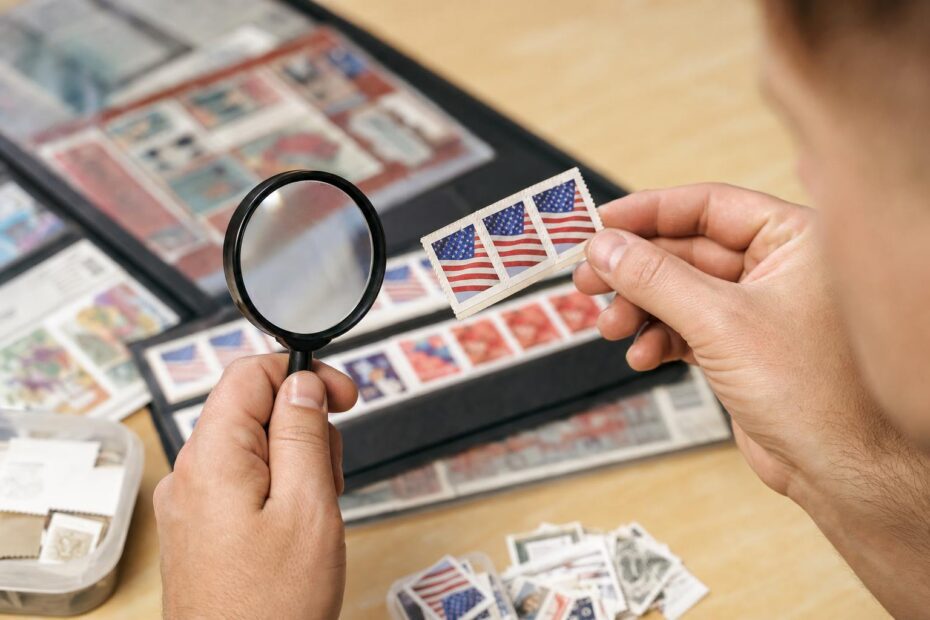
Forever stamps are advertised at large discounts on social media marketplaces and on discount websites, and a Forever stamp that is advertised at a large discount can be a counterfeit Forever stamp. The United States Postal Inspection Service has issued warnings about counterfeit Forever stamps, and mail that is sent with counterfeit Forever stamps is not delivered. The sections below describe the difference between a counterfeit Forever stamp and a genuine Forever stamp that is lawfully resold at a discount.
Why counterfeit Forever stamps exist
A Forever stamp carries no printed denomination and is worth the current First-Class Mail one-ounce rate whenever the Forever stamp is used. That property makes the Forever stamp attractive to counterfeiters, because a counterfeit Forever stamp does not have to match a specific rate in order to look plausible to a buyer. A counterfeit Forever stamp only has to resemble a genuine Forever stamp closely enough to be accepted at the moment of purchase.
The current First-Class Mail one-ounce rate is 82 cents, which took effect on July 12, 2026. A counterfeit Forever stamp sold at a deep discount therefore appears to offer a saving against the 82 cent rate, and the apparent saving is the entire basis of the offer.
What the Postal Inspection Service says
The United States Postal Inspection Service states that counterfeit stamps are commonly sold in bulk at a significant discount, described as anywhere from 20 to 50 percent of face value. The Postal Inspection Service identifies social media marketplaces, e-commerce sites operating through third-party vendors, and standalone websites as the places where counterfeit stamps are most often offered.
The Postal Inspection Service also states a rule that resolves most cases on its own: the Postal Service does not sell stamps below face value. An offer that presents itself as coming from the Postal Service, or as an official clearance of postage, and that prices stamps below face value, is not what the offer claims to be.
The difference between a counterfeit and a legitimate discount
A discount by itself is not evidence of a counterfeit, and this distinction is frequently reported incorrectly. Genuine unused postage that has already been purchased from the Postal Service may be resold lawfully, because the postage was validly issued and the postage has not been used. The Postal Inspection Service acknowledges that legitimate warehouse retailers offer small discounts under resale agreements with the Postal Service.
The characteristic that separates a counterfeit from a lawful resale is not the size of the discount. The characteristic that separates a counterfeit from a lawful resale is whether the stamp was ever validly issued by the Postal Service at all. A counterfeit Forever stamp was never issued by the Postal Service and carries no postage value of any kind. A genuine unused Forever stamp resold by a dealer retains the full current First-Class rate in postage value regardless of the price the dealer charged.
The source of the Forever stamps is therefore a more reliable indicator than the price of the Forever stamps. A seller that can document the origin of the Forever stamps is in a different position from an anonymous seller that lists Forever stamps in bulk on a marketplace.
Warning signs on a listing
- A discount of roughly 20 to 50 percent below face value, which is the range that the Postal Inspection Service describes, is offered on a large quantity of Forever stamps.
- The seller has no verifiable business identity, and the seller operates only through a marketplace account or through a recently registered website.
- The listing claims that the Forever stamps are surplus, clearance or overstock sold directly by the Postal Service, although the Postal Service does not sell stamps below face value.
- The seller requests payment by a method that does not support a chargeback.
- The quantity offered is far larger than the quantity that a retail customer is normally offered, and the quantity is sold at a uniform price per stamp.
Physical characteristics of a counterfeit
A counterfeit Forever stamp is produced to resemble a genuine Forever stamp, and no single physical test identifies a counterfeit Forever stamp with certainty. A genuine Forever stamp is printed to a consistent standard, and a departure from the consistent standard is the most reliable indicator that is available to a buyer. The perforations on a genuine Forever stamp are cut cleanly and evenly, and the perforations on a counterfeit Forever stamp are frequently irregular, shallow or partially uncut. The color registration on a genuine Forever stamp is precise, and the color on a counterfeit Forever stamp is often shifted, flat or duller than the color on a genuine Forever stamp.
A comparison of a questionable Forever stamp against a Forever stamp of known origin is more reliable than an examination of the questionable Forever stamp alone. A Forever stamp that was purchased directly from a Post Office serves as a reference sample, and the questionable Forever stamp can be compared against the reference sample for paper weight, adhesive behavior, perforation quality and color.
What happens to mail sent with counterfeit postage
Mail bearing counterfeit postage is not returned to the sender and is not delivered to the addressee. The Postal Inspection Service states that items mailed with counterfeit postage are considered abandoned and are subject to being opened and disposed of at the discretion of the Postal Service. The mail piece and the contents of the mail piece are both lost, and no notification is issued to the sender.
Purchasing or using counterfeit postage is also illegal. The Postal Inspection Service cites Title 18 of the United States Code, Section 501, and states that a person involved may be liable for criminal penalties, civil penalties, or both.
Where genuine stamps are sold
Genuine Forever stamps are sold by the Postal Service directly, at a Post Office counter and through the official stamp store at store.usps.com, and by businesses designated as Approved Postal Providers. A current list of approved providers is published by the Postal Service. Purchasing through either of those channels removes the question entirely, because the postage is issued and sold by the Postal Service or by a business operating under an agreement with the Postal Service.
Selling unused Forever stamps is a separate matter
Selling genuine unused Forever stamps that were lawfully purchased is not affected by any of the above. The postage was validly issued, the postage has not been used, and the postage retains its full face value in the hands of a buyer. A seller disposing of unused postage is in an entirely different position from a buyer acquiring counterfeit postage, and the two situations should not be confused with one another.
Turn genuine unused stamps into cash
If you have unused Forever stamps you’ll never get through, we buy them. We pay 50 percent of face value for First-Class, Global, 2 Ounce and 3 Ounce Forever stamps, and you’ll know what your stamps are worth before you send anything. Start on the sell Forever stamps page, or check the full rate table on the what we pay page first. For the current postage value of what you’re holding, see Forever stamp values.
We’ve been buying unused postage since 2016 and we’ve paid out over $7.4 million to more than 3,200 customers. Every stamp we buy is genuine postage that someone bought from the Post Office and never used.