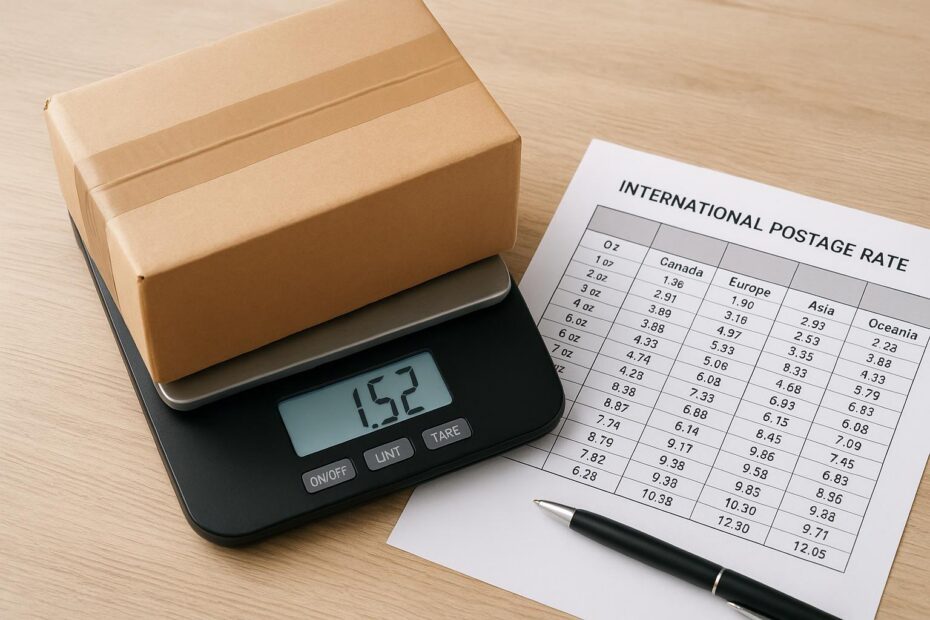
You don’t need a spreadsheet to understand how international postage grows as soon as something gets heavier. You need a clear sense of the rules carriers use, the places where costs jump, and the small handling choices that force you to pay more. This is the working handbook for that.
## International Weight-Based Postage Guide For Practical Shipping
Weight is the baseline most carriers use to price an international shipment. That’s obvious, but the way they band, round, and add fees makes it anything but straightforward. This international weight-based postage guide walks through the mechanics, shows where money tends to leak out, and gives practical moves to keep costs down without cutting corners on documentation or service.
### How Carriers Use Weight Bands
Carriers rarely charge by the exact gram. Instead they create bands: under 100 g, under 250 g, up to 500 g, 1 kg, 2 kg, and so on. The first band is often the cheapest. After that, prices climb in uneven steps. Those steps, not linear meter-by-meter costs, are what you need to watch.
– Postal services (national carriers) typically have finer bands at the low end and then wider bands beyond 1–2 kg.
– Couriers use both weight and volume for pricing; a light but bulky box might be charged as heavy if it exceeds volumetric thresholds.
This matters because one extra gram can push a parcel into the next band and raise your cost by a noticeable percentage. Use this international weight-based postage guide to spot those thresholds before you seal the box.
### Why Zones And Weight Multiply Costs
Zones are geographic buckets used with weight. Shipping 500 g to a neighboring country might be cheap; shipping the same weight across continents is expensive. The two variables—weight band and destination zone—multiply, not add. So controlling weight is more valuable when you ship far.
#### Zone Examples And Typical Behaviors
– Short hops inside a region often have small increases between bands.
– Intercontinental parcels see larger jumps between bands, so takeaways like removing non-essential packing material pay off more.
### Packaging Choices That Affect Weight
Most people overpack. Extra cardboard, double bubble wrap, oversized boxes—these add grams and move you into a higher band. That’s why this international weight-based postage guide focuses on packaging as a cost lever.
Cut wasted space. Use the smallest box that protects the item. Replace bulky fillers with thin, protective wraps where possible. For fragile items consider microfoam or kraft paper instead of heavy foam inserts. Every saved gram matters.
### How To Weigh Accurately
Home scales can be wrong. I’ve seen postal clerks reject hand-printed weights three times because the scale in the lobby read differently. Buy a decent shipping scale (5 kg capacity and 1–5 g precision) or weigh at the post office before finalizing your label. Weigh the item after packaging because that’s the number carriers use.
If you use a marketplace or label-printing service, their system will often require you to select a weight band. If you choose too low and the carrier finds it heavier, you’ll likely be billed the difference plus handling fees. That’s where extra international postage comes in; unexpected adjustments during transit are more expensive than getting it right at the origin.
### Declared Weight, Customs, And Liability
Declared weight is more than postage. It feeds customs paperwork, insurance claims, and delivery commitments. Undervaluing or understating weight to save money is a bad bet. If a customs inspection finds a discrepancy, you can be hit with fines, returned shipments, or seized items. This international weight-based postage guide treats declared weight as a compliance point, not a negotiation.
#### Customs Form Tips
– Accurately list both the value and the weight in each line item. Don’t lump items into a single vague description.
– If you include promotional samples, mark them correctly. Value and weight both matter to assessment officers.
– Keep invoices and packing lists accessible; if customs asks, you’ll need to provide them quickly.
### Extra Fees That Sneak Up
Beyond the basic banded charge, carriers add surcharges: fuel, remote-area delivery, carrier-specific handling, and sometimes an oversized fee. Some of these apply only after certain weights or dimensions. This is where the phrase extra international postage becomes relevant: it’s the payment you didn’t budget for.
Common triggers for extra international postage:
– Oversize parcels (long length plus girth exceeding limits)
– Non-standard shapes (cylinders, tubes, odd angles)
– Incorrect or missing documentation that requires rerouting
One non-obvious point: if the package is light but very large, many carriers will apply a volumetric weight calculation. Your item then pays as if it were heavier. Packaging design should balance protection and compactness.
### Pricing Examples That Reveal Patterns
Let’s run through a few simplified examples so the math lands:
– Small jewelry item: weight with packaging 80 g. Stays in the lowest band and is cheap to send worldwide via small packet services.
– Shirt in a thin poly bag: 200 g. Some countries move from the lowest to the second band at 100 g or 250 g. That tiny shift can be a 25–50% price jump.
– Electronics in a box: 1.2 kg. Once you cross the 1 kg band, international fees and insurance choices make the shipment more costly.
Those snapshots show how different items fall into different pain points. Use this international weight-based postage guide to map common SKUs you ship and mark the band thresholds that matter.
### Carrier Choices And When To Use Them
National postal services are usually best for small, low-value stuff. Couriers (DHL, FedEx, UPS) excel for heavier, higher-value items, and they often beat post on speed and tracking—even if the baseline postage looks higher. The trick is to run the actual quotes for your typical parcel, not a single sample.
If you ship a lot, negotiate. Volume discounts can swing rates dramatically. For small-volume sellers, consolidators and broker services can offer better rates using pooled volume.
### Insurance, Tracking, And Cost Tradeoffs
Adding insurance raises your per-shipment cost but saves pain when something goes wrong. Tracking level matters too; some cheap international options offer limited tracking, which increases the chance of disputes. Think of extra insurance and upgraded tracking as risk management—sometimes worth the cost when the item value rises.
If a buyer demands signature on delivery or higher insurance, that will almost always increase postage. Factor that into the product price or shipping policy.
### Practical Steps For Cutting Costs
– Design packaging for the lowest likely band for your product line. If you can get most items under the 500 g band, you’ll save across thousands of shipments.
– Use return-free packaging: smaller outer box, pre-paid return labels for easy returns. This reduces exchanges that inflate cumulative weight and cost.
– Batch shipments where possible. Consolidate multiple small orders to the same destination into a single parcel to exploit weight slabs more efficiently.
– Use regional hubs for repeat markets. Ship in bulk to an EU or North American hub and distribute locally to avoid repeating expensive cross-border moves.
### Labeling And Post Office Practices
A common point of friction is when the post office reweighs a package and applies an adjustment. Be calm. Ask to see the weight, and if it differs from yours, ask them to weigh it again on another scale. If that doesn’t work, accept the adjustment and learn from it: adjust your packing or scale.
When printing labels at home, leave the customs form visible and don’t cover tracking numbers with tape. Sloppy labeling yields delays and sometimes extra international postage for manual handling.
### International Returns And Reverse Logistics
Returns double the transport cost. Pre-authorize return labels that use lower-cost methods when possible. For example, a customer in the same region can return via local postal services; then use a regional shipper to move bulk returns. This approach reduces the chance of being hit repeatedly by pricing bands.
If your return policy causes customers to send heavy items back (chargers, manuals), include a note to remove accessories that are not necessary for return. You’ll save on cumulative weight.
### Tools And Resources Worth Using
– Get a reliable shipping scale and a small set of calibrated weights.
– Use carrier rate calculators and compare for representative package sizes.
– Invest time in a spreadsheet that maps your top SKUs to postal bands and typical routes—this is where the savings show up every month.
This international weight-based postage guide is not theoretical. It’s a set of practical choices: how you pack, what you declare, which service you pick, and how you handle exceptions. Make those choices deliberately and the savings add up.
### Common Mistakes People Make
Some mistakes repeat across sellers and shippers:
– Underestimating the total shipping weight because of heavy packaging.
– Ignoring volumetric weight rules for bulky items.
– Not accounting for carrier surcharges in prime seasons.
– Failing to prepare clear customs invoices, which triggers manual processing and extra international postage.
Address those and you’ll avoid most surprise bills.
### When To Pay More Without Regret
There are times when spending a bit extra is the rational move. High-value electronics, fragile goods, or time-sensitive deliveries justify paying for better tracking, insurance, and faster transit. The math is simple: the cost of a lost high-value item plus customer relations fallout is usually higher than paying a few extra dollars for secure transit.
Now look at your current shipments. Check the thresholds where costs jump. Test a lighter box. Weigh before you print the label. Recieve feedback from your carrier, and iterate. The savings come from small, consistent choices.